🕹️
The Legend of Zelda: Ocarina of Time
1998
.png)
NINTENDO-64
10
Reviewed by Marcus Webb & Elena Castillo ·
Technos Japan's 1990 NES beat-em-up and the widely beloved sequel to Double Dragon — Double Dragon II: The Revenge adds the spinning Hurricane Kick and Cyclone Spin Kick as core mechanics, improves two-player cooperation with a side-by-side rather than competitive structure, features Marian's death as the inciting narrative event, and delivers more complex level design than the original across nine missions.
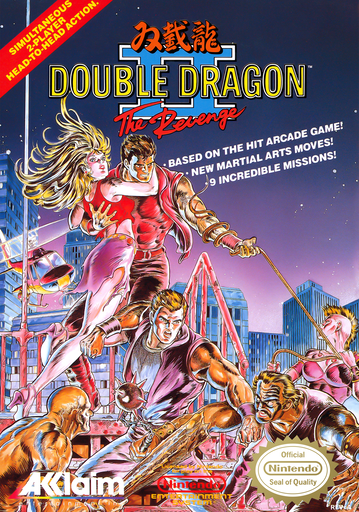
Marian is shot in the opening cutscene. Billy Lee watches it happen. The Black Warriors responsible have a mission to complete and nine stages to protect them.
Double Dragon II came to NES in 1990 with a narrative justification, cooperative play that actually worked, and the spinning kick that made the sequel worth the name.
The original Double Dragon’s NES port had the elbow — the reliable crowd-control move that cleared groups. Double Dragon II replaced it with something more spectacular.
The Hurricane Kick is a jump-and-spin: leave the ground, press attack, spin horizontally through any enemy in contact range. In a group of three Black Warriors, the Hurricane Kick catches all three simultaneously. It’s the kind of move that changes how the game looks when executed — a spinning blur through an enemy pack that clears faster than any direct approach.
The ground-level Cyclone Spin Kick extends the spinning toolkit. Two spinning attacks with different range applications gave Double Dragon II a distinctive combat feel compared to the original’s elbow-heavy approach.
Original Double Dragon NES: two players. But not simultaneously. One player controls, then the other. Alternating turns, not cooperation.
Double Dragon II fixed this. Billy and Jimmy on screen together, simultaneously, through all nine missions. Attacks don’t damage the partner — the cooperative intent is genuine rather than competitive. Two Hurricane Kicks in the same enemy group from opposite approach angles creates the kind of coordinated chaos that explained why the beat-em-up genre built its design around co-op.
Most ports cut arcade content. Cartridge limitations, time constraints, publisher decisions — the home version arrives with less than the coin-op.
Double Dragon II went the other direction. The NES version includes missions beyond the arcade game’s content — approximately one-third more game, exclusive to the home version. Players who’d finished the arcade discovered additional enemies, environments, and encounters after the apparent conclusion.
The reversal was unusual enough to be remembered: this was the Double Dragon where staying home gave you more than going to the arcade.
Double Dragon II is a side-scrolling beat-em-up across nine missions where Billy Lee (player 1) and Jimmy Lee (player 2) fight through the Black Warriors gang to avenge the murder of Marian. The attack system now uses directional inputs — attacking left or right depending on the d-pad direction — with the Hurricane Kick (spinning kick) added as a powerful crowd-clearing move. Two-player mode is fully cooperative: players don't accidentally hit each other, removing the competitive damage mechanic of the original. Mission variety includes helicopters, moving platforms, and indoor/outdoor environments. An NES-exclusive final section beyond the arcade version adds approximately one-third more content.
Double Dragon II's NES visuals represent an advancement over the original's graphics — more detailed character sprites, varied indoor and outdoor environments, and the series' characteristic digitized-from-film-reference aesthetic for character designs.
Double Dragon II's NES soundtrack includes the iconic Mission 1 theme and stage-appropriate action compositions. The music quality is considered a high point of NES beat-em-up audio.
Nine missions with two-player co-op, character mastery of the Hurricane Kick and Cyclone Spin Kick, mission 9's additional NES content, and the beat-em-up replay structure of different enemy configurations provide solid genre replay.
Double Dragon II (1990 NES) is broadly considered an improvement over the original Double Dragon NES port and stands as one of the NES's best beat-em-ups. The NES version's additional final missions beyond the arcade version created unique content — a rare case where the home version exceeded the arcade source. The two-player cooperative fix — removing the accidental friendly-fire damage of the original — made co-op the intended two-player experience. The spinning kick additions influenced subsequent beat-em-ups in the genre. Double Dragon II's NES reception cemented the franchise's status alongside Battletoads and Final Fight as defining the NES action genre's end period.
.png)
.png)
.png)