Grand Theft Auto

Reviewed by Marcus Webb & Elena Castillo ·

DMA Design's 1997-1998 top-down action game and the origin of one of gaming's most influential franchises — Grand Theft Auto places a criminal in three cities (Liberty City, San Andreas, Vice City debuting here by name) to complete missions for various crime bosses, with a wanted level system, free-roaming open world, and unprecedented violence-as-mechanics that launched a cultural controversy alongside a beloved franchise.
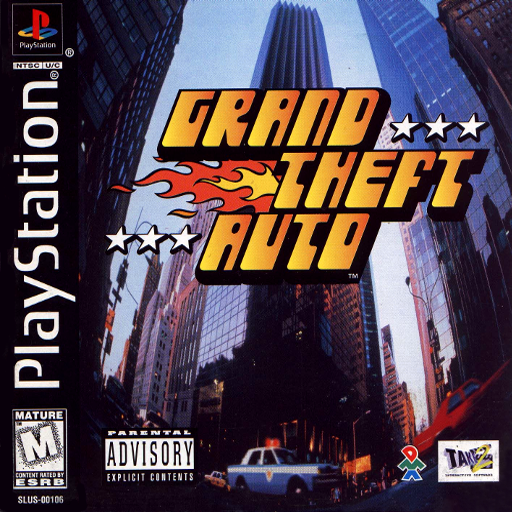
Grand Theft Auto box art

💡 Grand Theft Auto — Key Facts

  • Grand Theft Auto was developed by DMA Design and published by Rockstar Games
  • Released in 1998 on PLAYSTATION
  • Genre: Action
  • We rate it 8/10 — highly recommended
  • DMA Design's 1997-1998 top-down action game and the origin of one of gaming's most influential franchises — Grand Theft Auto places a criminal in three cities (Liberty City, San Andreas, Vice City debuting here by name) to complete missions for various crime bosses, with a wanted level system, free-roaming open world, and unprecedented violence-as-mechanics that launched a cultural controversy alongside a beloved franchise.

Overview

A top-down city. A criminal at the bottom of the underworld. Three cities, each with crime bosses who needed favors and didn’t distinguish between types of work.

Grand Theft Auto was 1997’s most controversial game and 1998’s most widely discussed entertainment product. It was also the origin of the concept that would become gaming’s highest-grossing franchise.

The Three Cities

Liberty City. San Andreas. Vice City.

These names didn’t become famous in 1997. They became famous in 2001, 2002, and 2004, when Rockstar used them for GTA III, Vice City, and San Andreas — 3D-era games that redesigned the settings with full polygonal graphics and became cultural phenomena.

The original GTA invented the names. The 3D sequels made them famous. The continuity was deliberate: Rockstar wanted players who’d played the 3D games to find the names familiar and know what geography to expect.

The Wanted Level

Stars accumulate. Patrol cars appear. FBI agents deploy. The National Guard arrives.

The Wanted Level system invented the police pursuit dynamic that every GTA sequel refined and that other open-world games spent the next decade trying to replicate. The escalation from one officer to military response created the proportionality that made pursuit memorable: small crimes drew small responses, major crimes drew major consequences.

The ability to reduce the level — finding a respray shop, escaping pursuit zone, bribing with phone — gave players agency over the escalation rather than making it a death spiral. The balance between generating Wanted Level and managing it became the game’s secondary loop alongside mission completion.

The Controversy

UK tabloids. Parliamentary questions. Parent advocacy groups. Grand Theft Auto arrived in an environment already primed for video game controversy by Mortal Kombat’s blood and Night Trap’s FMV content.

The game’s mechanics were the problem: carjacking was the core gameplay, not a narrative crime the player character committed offscreen. Running over pedestrians generated score multipliers. The Wanted Level escalation for police killing meant police killing was an intended activity.

The controversy sold the game and defined the brand. Every GTA sequel carried the implicit promise of transgressive content that the controversy established as the franchise’s identity. The serious formal games industry got the ESRB out of the conflict; Rockstar got a brand.

Our Review

8
Excellent / 10
🎮
Gameplay
★★★★★
🎨
Graphics
★★★★★
🎵
Audio
★★★★★
🔄
Replay
★★★★★

Gameplay

Grand Theft Auto is a top-down open-world action game viewed from above. Players take the role of an unnamed criminal completing missions for crime bosses across three city maps: Liberty City, San Andreas, and Vice City. Missions include driving to locations, eliminating targets, stealing vehicles, and transporting goods. The free-roaming sandbox allows stealing any vehicle, running from police, and pursuing optional crimes between missions. The Wanted Level escalates when crimes are committed in police view — from 1 to 6 stars — with progressively stronger police response. Multiplier scoring rewards committing crimes in sequence. The cities are deliberately oversized for their era, populated with traffic, pedestrians, and police.

Graphics

Grand Theft Auto's top-down 2D sprite perspective with rendered city environments was the practical choice for its open-world ambition on PS1 hardware. The scale of the three playable cities required the overhead view that 3D city rendering couldn't have provided.

Audio

Grand Theft Auto's radio stations — playable while driving stolen vehicles — introduced the franchise's characteristic fake pop/rock/news radio format. The station switching while speeding away from police introduced the audio experience that defined GTA's open-world feel.

Replayability

Three full city maps (Liberty City, San Andreas, Vice City) each with their own mission sequences, free-roaming multiplier scoring outside missions, and the sandbox violence mechanics create replay beyond the structured mission path.

Historical Significance

Grand Theft Auto (1997 PC; 1998 PS1) originated the open-world crime sandbox genre. The game's formula — free-roaming city, steal vehicles, complete criminal missions, escalating police pursuit — became one of gaming's most commercially dominant template. The controversy generated by GTA's violence, car theft, and pedestrian running made it one of the first games to generate mainstream media debate about video game violence alongside Mortal Kombat and Night Trap. The GTA franchise evolved through GTA2, GTA III (3D revolution, 2001), Vice City, San Andreas, IV, and V — but the original 1997/1998 game created the concept that all sequels built on. DMA Design later became Rockstar North.

Pros

  • + Origin of one of gaming's most influential franchise concepts
  • + Three full city maps — unprecedented scope for 1997/1998
  • + Wanted Level escalation creating pursuit tension
  • + In-car radio stations establishing the franchise's audio identity
  • + Free-roam sandbox independent of mission structure

Cons

  • - Top-down perspective limits visibility vs. 3D successors
  • - Mission objectives often unclear without guides
  • - Police AI can feel arbitrary in escalation triggers
  • - Violence controversy made the game notorious before widely played

Also Known As

GTA 1GTA PS1GTA originalGrand Theft Auto 1

Grand Theft Auto FAQ

What are the three cities in the original Grand Theft Auto?
The original Grand Theft Auto features three playable cities that serve as the game's full sandbox environments. Liberty City is the first available city — a New York City-inspired metropolis with grid streets, bridges, and dense urban layout. San Andreas is the second city — inspired by California and featuring a more sprawling Western American city layout different from Liberty City's dense grid. Vice City is the third city — a Miami-inspired locale with beachfront areas and a distinct visual palette. These three city names — Liberty City, San Andreas, Vice City — became the named settings of GTA III (Liberty City), GTA: Vice City (Vice City), and GTA: San Andreas (San Andreas) in the 3D era. The original game's city names were the first use of these now-iconic setting names, establishing geographic continuity across the franchise even as the settings were redesigned for 3D in later games.
What is the Wanted Level system in Grand Theft Auto?
The Wanted Level in Grand Theft Auto is a 1-to-6 star rating that indicates police attention toward the player character. Committing crimes — stealing vehicles, attacking pedestrians, shooting at police, running red lights — in view of police or witnesses increases the Wanted Level. At Level 1, local police officers pursue on foot and in patrol cars. At Level 2, more police respond with greater numbers. Higher levels (3-4) bring in FBI agents and roadblocks. At Level 5-6, the National Guard and military vehicles respond. The Wanted Level can be reduced by escaping the pursuit area or locating a Pay 'n' Spray car respray shop to change the vehicle's appearance. The escalation system created the cat-and-mouse police pursuit dynamic that became one of GTA's most defining features, refined through every sequel.
How did Grand Theft Auto cause controversy?
Grand Theft Auto (1997/1998) generated significant controversy upon release due to its combination of criminal protagonist gameplay and explicit violence. The game allowed players to steal vehicles by carjacking occupants, run over pedestrians for score multipliers, and kill police officers. The Wanted Level system directly encouraged engaging police in extended gunfights. UK tabloids called for the game's banning upon its PC release in 1997. The PS1 release in 1998 brought the controversy to mainstream gaming audiences. Politicians and parent advocacy groups cited GTA alongside Mortal Kombat as evidence that video games required stronger content regulation. Despite — and partly because of — the controversy, the game sold strongly and established the GTA brand's 'transgressive entertainment' identity. The controversy intensified dramatically with GTA III's 3D graphics in 2001 and continued through Hot Coffee's content in GTA: San Andreas.
Is the original Grand Theft Auto available on modern platforms?
The original Grand Theft Auto (1997/1998) and its expansion GTA London 1969 are available for free download from Rockstar Games' official website as a permanent free offering — Rockstar has made the original GTA and GTA 2 freely downloadable. The PC version is available through Rockstar's free download. The PS1 physical disc is available in retro game markets but the PS1 version specifically is not on modern digital storefronts. GTA 2 (1999) is also available as a free Rockstar download. The franchise continues through GTA VI (announced for release). The original top-down GTA games represent the franchise's origin but are rarely the entry point for modern players — GTA III (2001), Vice City (2002), and San Andreas (2004) are the most played entries in the classic era.

Related Games

Games Like This →