Super Star Wars: The Empire Strikes Back

Reviewed by Marcus Webb & Elena Castillo ·

JVC's 1993 SNES action-platformer and the middle entry of the Super Star Wars trilogy — Super Star Wars: The Empire Strikes Back adapts Episode V with Luke's Force training on Dagobah, the Battle of Hoth with AT-AT walkers, Cloud City's lightsaber duel, and introduces the Force ability upgrade system where Luke learns new Force powers through gameplay progression.
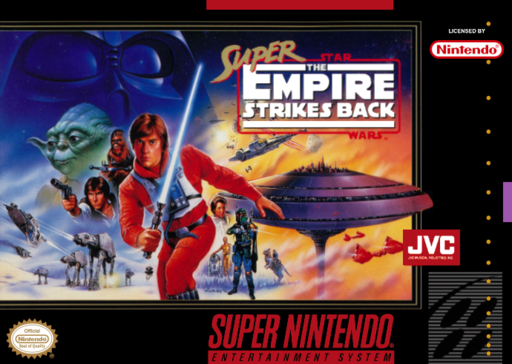
Super Star Wars: The Empire Strikes Back box art

💡 Super Star Wars: The Empire Strikes Back — Key Facts

  • Super Star Wars: The Empire Strikes Back was developed by Sculptured Software and published by JVC
  • Released in 1993 on SNES
  • Genre: Action, Platformer
  • We rate it 9/10 — an absolute classic
  • JVC's 1993 SNES action-platformer and the middle entry of the Super Star Wars trilogy — Super Star Wars: The Empire Strikes Back adapts Episode V with Luke's Force training on Dagobah, the Battle of Hoth with AT-AT walkers, Cloud City's lightsaber duel, and introduces the Force ability upgrade system where Luke learns new Force powers through gameplay progression.

Overview

Hoth. The Imperial March. A lightsaber against Darth Vader in Cloud City’s carbonite chamber.

The Empire Strikes Back gave JVC’s second SNES entry better source material and they made better use of it.

The Force Upgrade

Luke begins with a lightsaber and basic Force capability. Dagobah’s training — the Yoda sessions that the film compresses into a brief middle-act interlude — becomes gameplay content: stages where completing challenges yields new Force powers.

Push. Jump. Slow. Each ability changes what Luke can do in subsequent stages. Force Jump reaches platforms that Force-less Luke cannot. Force Push creates a ranged option beyond the lightsaber’s melee range. Force Slow turns dense bullet patterns into navigable streams.

The original Super Star Wars had no equivalent progression — the characters were fixed throughout. ESB added development to Luke’s capability arc in a way that matched the film’s narrative: by Cloud City, Luke is a different fighter than the Tatooine farmboy who started Hoth.

The AT-ATs

The Battle of Hoth’s AT-AT walkers on Mode 7.

Scale was the challenge: how to represent a four-legged walker that in the film fills the horizon without proportional sprites. Mode 7 scaling — the same technique that made F-Zero’s track curve ahead — approached the AT-ATs as objects that expanded as Luke drew close rather than fixed-size sprites. The visual impression was the closest the SNES could get to the film’s sense of mechanical scale.

The snowspeeder stage followed the same Mode 7 vehicle format as the original’s Millennium Falcon, adapted for the snowspeeder’s atmospheric flight physics. Two Mode 7 sequences in one battle, each using the technique differently.

The Vader Duel

Cloud City’s carbonite chamber. Darth Vader with a red lightsaber.

The climactic encounter is a lightsaber duel designed as a skill benchmark — Vader attacks with patterns that require the full Force toolkit Luke has acquired. Players who arrived at Cloud City with all powers and the skills to use them found a demanding but fair boss fight. Players who’d taken shortcuts found a wall.

The duel ends as the film ends. The revelation comes. The escape into the Millennium Falcon follows. The trilogy’s best chapter concluded.

Our Review

9
Outstanding / 10
🎮
Gameplay
★★★★★
🎨
Graphics
★★★★★
🎵
Audio
★★★★★
🔄
Replay
★★★★★

Gameplay

Super Star Wars: The Empire Strikes Back is a side-scrolling action platformer across nine stages adapting Episode V. Luke Skywalker is the sole playable character — Han Solo and Leia are not playable as in the original, focusing the campaign on Luke's Jedi training arc. Luke fights with lightsaber, Force powers, and blaster through stages including the Hoth ice planet, Dagobah swamp, Asteroid Field (Mode 7 ship sequence), Cloud City, and the Vader duel. The Force power upgrade system allows Luke to gain new Force abilities: Force Push, Force Jump, Force Slow. A tauntaun riding stage uses the same Mode 7 approach as the original's landspeeder. The game is considered the finest of the JVC SNES Star Wars trilogy by most players.

Graphics

Super Star Wars: ESB's SNES visuals are a clear advancement over the original — larger, more detailed sprites, more atmospheric stage backgrounds, and the Battle of Hoth's AT-AT walkers providing impressive Mode 7 sequences that the original landspeeder couldn't match.

Audio

The Empire Strikes Back score — Imperial March, Yoda's Theme, the Asteroid Field music, Cloud City themes — is faithfully adapted for SNES hardware. The Imperial March's SNES arrangement is one of gaming's most recognizable licensed music translations.

Replayability

Force power progression across stages, Jedi difficulty challenge, the Vader lightsaber duel as skill benchmark, and the game's reputation as the trilogy's finest entry create revisit incentive beyond linear completion.

Historical Significance

Super Star Wars: The Empire Strikes Back (1993) is generally regarded as the best of JVC's three SNES Star Wars games and one of the finest licensed adaptations in 16-bit gaming. The Force upgrade system added RPG-adjacent progression to the platformer structure. The Hoth battle's AT-AT sequences are technically impressive for SNES hardware. The lightsaber duel against Vader is one of the 16-bit era's most memorable boss encounters. The game's quality elevated the JVC Star Wars trilogy from commercial licensed product to a genuinely celebrated gaming achievement.

Pros

  • + Force upgrade progression system — Luke gains new powers through stages
  • + AT-AT walker Battle of Hoth sequence — technically impressive Mode 7 use
  • + Vader lightsaber duel as climactic boss encounter
  • + Imperial March SNES arrangement — finest of the trilogy's music
  • + Generally considered the best of the JVC Super Star Wars trilogy

Cons

  • - Luke sole playable character — no Han or Leia as in original
  • - Dagobah training stages can be monotonous before Force upgrades
  • - High difficulty inherited from the original trilogy
  • - Luke's depiction ages differently than the film's character arc

Also Known As

Super Empire Strikes Back SNESSuper Star Wars ESBスーパースターウォーズ帝国の逆襲

Super Star Wars: The Empire Strikes Back FAQ

What Force powers does Luke gain in The Empire Strikes Back?
Super Star Wars: The Empire Strikes Back introduces a Force power upgrade system where Luke acquires new abilities as he completes stages and receives Jedi training on Dagobah. The Force abilities include Force Push — a ranged Force blast that damages enemies and can be used in combat; Force Jump — enhanced jumping ability that allows Luke to reach platforms otherwise inaccessible; Force Slow — slowing enemies and projectiles for a brief period, useful in dense combat situations. Additional Force powers unlock through gameplay progression. The system provides RPG-adjacent character growth within the platformer structure: early-game Luke is a relatively standard lightsaber combatant; late-game Luke with full Force abilities has multiple tools for different situations. Yoda's Dagobah training stages serve as the narrative justification for the power acquisition.
How does the Hoth sequence work?
The Battle of Hoth is one of Super Star Wars: ESB's most impressive sequences. Luke begins on the Hoth ice planet on foot, fighting Snowtroopers and Wampa creatures. The AT-AT walker stages use Mode 7 scaling — the massive Imperial walkers scale as Luke approaches them in a mechanic that demonstrates SNES hardware capabilities. A snowspeeder stage uses the same Mode 7 behind-the-vehicle perspective as the original Super Star Wars's Millennium Falcon section, adapted for the snowspeeder's flight characteristics. The AT-AT battle is the player objective before Luke can escape Hoth for Dagobah — the sequence compresses the film's Hoth evacuation into a series of combat challenges that preserve the battle's scale through Mode 7 tricks. The Hoth sequence is frequently cited as the most technically impressive section of the JVC SNES trilogy.
What makes this game considered better than the original Super Star Wars?
Super Star Wars: The Empire Strikes Back is generally regarded as the best of the JVC SNES trilogy for several reasons. The Force upgrade system adds progression depth absent from the original — Luke's abilities expand across the game, creating investment in stage completion beyond simple clearing. The stage variety is greater: Hoth's ice planet, Dagobah's swamp, the asteroid field, Cloud City's architecture, and the Vader duel provide more environmental diversity than the original's Tatooine-heavy setting. The source film is also broadly considered superior — adapting The Empire Strikes Back provided more dramatic material to work with. The AT-AT walker sequences and Vader lightsaber duel represent higher technical and design ambitions than equivalent sequences in the original. Players who complete all three JVC Star Wars games typically identify ESB as the peak despite all three being high quality licensed adaptations.
Is Super Empire Strikes Back available on modern platforms?
Super Star Wars: The Empire Strikes Back is available on Nintendo Switch Online's SNES library for Nintendo Switch Online subscribers alongside Super Star Wars. The game also appeared on PS4 and PS Vita digitally. Physical SNES cartridges are available in retro game markets. Super Return of the Jedi (1994) completes the trilogy, also available on Switch Online. The Star Wars license situation under Disney (which acquired Lucasfilm) has maintained the JVC trilogy's digital availability as part of the broader Star Wars IP library management. All three Super Star Wars games are included in Nintendo Switch Online's SNES catalog for Western subscribers.

Related Games

Games Like This →