🕹️
The Legend of Zelda: Ocarina of Time
1998
.png)
NINTENDO-64
10
Reviewed by Marcus Webb & Elena Castillo ·
JVC's 1994 SNES action-platformer and the conclusion of the Super Star Wars trilogy — Super Star Wars: Return of the Jedi expands the playable roster to four characters (Luke, Han, Leia, Wicket the Ewok), adapts Episode VI's Tatooine desert, Endor forest, and Death Star II locations with Mode 7 vehicle sequences for the speeder bike chase and Millennium Falcon run, and delivers the series' largest character variety.
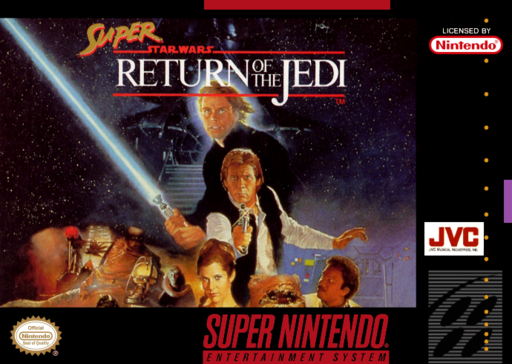
Jabba’s Palace. Endor’s forest. The Death Star II’s reactor core. The Emperor on his throne.
Super Star Wars: Return of the Jedi closed the JVC trilogy in 1994 with four characters and the speeder bike sequence that players still cite as the series’ finest moment.
Previous entries had limits. The original gave three characters but focused on Luke. Empire Strikes Back narrowed to Luke alone across the full campaign. Return of the Jedi expanded: four characters, each with actual stages designed for them.
Leia’s playable stages were notable in 1994. A female protagonist across multiple platform game sections wasn’t common in licensed games of the era. Her Endor stages played differently than Luke’s Force-heavy approach and Han’s gunslinger positioning.
Wicket is the genuine novelty. An Ewok as a playable character in an action platformer requires reimagining what the stage design looks like — the Endor forest stages built for Wicket’s sling and movement properties are unlike any stage in the previous two games. The series’ most unusual content is the Ewok gameplay.
Mode 7 had been used across the trilogy. The landspeeder, the Millennium Falcon, the AT-AT approach. Each used the scaling technique for different effect.
The speeder bike chase is what Mode 7 can do when the sequence’s premise perfectly matches the technique’s strengths: speed, obstacle avoidance, forward momentum through a scaling environment. Endor’s forest canopy scales at the velocity that the chase in the film suggested — not quite the same as the film’s camera, but the closest SNES hardware could approximate to that sense of motion.
The sequence is short — the game can’t sustain it across a full stage. The brevity might be why it’s remembered so positively: the Mode 7 speeder bike is an experience concentrated into its optimal duration.
Three games. Three films. The trilogy ends with Luke facing Palpatine and the Death Star’s destruction.
The JVC Star Wars trilogy is one of the licensed game series that exceeded expectations at every entry. Not because Star Wars guaranteed quality — it didn’t, the franchise’s gaming history is inconsistent — but because Sculptured Software and JVC understood what the SNES could do with the source material and did it at each opportunity.
Super Star Wars: Return of the Jedi adapts Episode VI with four playable characters for the first time in the trilogy. Luke (lightsaber, Force powers), Han Solo (blaster), Princess Leia (blaster, multiple stage appearances as protagonist), and Wicket the Ewok (sling, unique movement on Endor stages) each have distinct combat approaches. Eleven stages cover Jabba's Palace, the Sarlacc Pit, Endor forest, the speeder bike chase (Mode 7), the Death Star II, and the final Emperor confrontation. Luke's Force abilities from Empire Strikes Back continue with full powers from the start. The Ewok village stages and Endor sequences are the game's most distinct visual environments.
Return of the Jedi's SNES visuals cover the film's most varied environments — Tatooine's desert palace, Endor's forest moon, the Death Star II's interior — with the JVC trilogy's characteristic detailed sprite work. The speeder bike Mode 7 sequence is one of SNES's most impressive showcase moments.
The Return of the Jedi score — including the Ewok celebration theme, Emperor's throne room music, and speeder bike chase compositions — appears in SNES adaptations closing the trilogy's audio arc with appropriate thematic completeness.
Four playable characters with distinct movesets, eleven stages including Ewok-exclusive content, Mode 7 speeder bike and Millennium Falcon sequences, and the series finale narrative provide trilogy-completion replay for Super Star Wars players.
Super Star Wars: Return of the Jedi (1994) completes JVC and Sculptured Software's three-game SNES Star Wars trilogy. The addition of Leia and Wicket as playable characters expanded character variety beyond the previous games' more limited rosters. The speeder bike Mode 7 sequence is frequently cited as one of SNES's most impressive Mode 7 implementations. The trilogy — Super Star Wars, Empire Strikes Back, Return of the Jedi — is collectively considered among the finest licensed game series of the 16-bit era, with ESB generally rated highest, ROTJ second, and the original third.
.png)
.png)
.png)