🕹️
The Legend of Zelda: Ocarina of Time
1998
.png)
NINTENDO-64
10
Reviewed by Marcus Webb & Elena Castillo ·
SNK's 1994 SNES port of the Neo Geo weapons-based fighting classic — Samurai Shodown brings the feudal Japan samurai fighter to SNES with 12 characters including Haohmaru, Nakoruru, and Earthquake, the weapon clash and disarm mechanics, rage mode that powers up attacks when health is low, and the game's characteristic one-hit-kill potential that distinguished it from contemporaries.
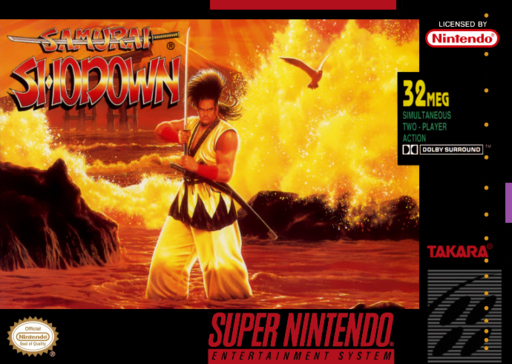
A single slash of Haohmaru’s katana across an opponent’s torso. The fight isn’t decided by attrition — it’s decided by the moment one player’s guard breaks and a weapon connects cleanly.
Samurai Shodown was SNK’s argument that the fighting game genre didn’t have to be Street Fighter II.
Street Fighter II’s combat is cumulative. Punches and kicks accumulate damage across a round until one fighter’s health depletes. The individual hit matters less than the sustained exchange.
Samurai Shodown’s weapon-based combat changes the mathematics. A clean katana hit deals a fraction of the health bar in one contact. A perfect slash in the right situation — opponent vulnerable, no block — ends a round in seconds. The risk-reward calculation is entirely different: committing to an attack that misses opens the attacker to a devastating counter rather than a minor disadvantage.
This changes everything about how fights proceed. Patient, defensive play — waiting for openings rather than creating pressure — suits Samurai Shodown’s high-damage environment more than Street Fighter’s aggressive combo-building philosophy.
The character who has been absorbing punishment has a full rage meter. Their next attacks deal substantially more damage.
This is Samurai Shodown’s acknowledgment that weapons-based combat creates asymmetric situations fast — a lead built through one successful exchange can feel insurmountable without a comeback mechanism. Rage mode creates the possibility that the trailing player can still win with one successful rage-powered attack sequence.
It also creates tension for the leading player: pressing for the finish risks the opponent’s rage activating under maximum conditions.
The Neo Geo original had large sprites and full blood. The SNES version has reduced sprites and sweat.
The trade-off was access. The Neo Geo’s hardware cost eliminated most home players from experiencing Samurai Shodown in its original form. The SNES port brought the game to millions of players at SNES prices. What was lost in visual fidelity was gained in audience — the game’s fighting mechanics survived the port even as its presentation was reduced.
For players who didn’t have Neo Geo access in 1994, the SNES version was Samurai Shodown. That version mattered enough to establish the franchise’s identity beyond the arcade community.
Samurai Shodown SNES is a port of the 1993 Neo Geo weapons-based fighter. 12 characters including Haohmaru (balanced samurai), Nakoruru (nature spirit/hawk), Charlotte (French fencer), Galford (American with dog), Wan-Fu (Chinese warrior), Earthquake (enormous American outlaw), Gen-an (grotesque monster), Kyoshiro (kabuki performer), Tam Tam (tribal warrior), Jubei (one-eyed samurai), Genjuro (elegant ronin), and Shiki. Gameplay features weapon-based combat where slashes deal massive damage versus Street Fighter's cumulative hit fighting. Disarming an opponent by hitting their weapon creates a temporary advantage. The Rage Meter fills as players take damage — when full, attack power temporarily increases, allowing comeback victories. Blood is present in the Neo Geo version (SNES version uses sweat substitute).
Samurai Shodown's SNES visuals adapt the Neo Geo's large character sprites with some reduction — the SNES version loses some animation frames and sprite detail compared to the arcade, but maintains the game's distinctive feudal Japan aesthetic.
The feudal Japan soundtrack — shamisen, taiko drums, and period-appropriate instruments in synthesized form — creates a distinctive audio identity from the era's contemporary and futuristic fighting game settings. Each character has stage-appropriate music.
12 diverse characters spanning Japanese, European, American, and Asian fighting styles; weapon-based combat creating massive-damage moments; rage mode comeback mechanics; and single-miss potential fights create fighting game tension and replay motivation.
Samurai Shodown (1993 Neo Geo) was SNK's response to Street Fighter II's dominance — not a SF2 clone but a fundamentally different fighting game built around weapons, single-hit potential damage, and a period Japan setting. The SNES port (1994) brought the game to a mass market beyond Neo Geo's expensive hardware. Samurai Shodown's weapon-based mechanics, rage system, and setting distinguished it from the SF2 clone era and established a fighting game subgenre. The franchise continued through multiple sequels. The SNES version's blood removal and sprite reduction were trade-offs for platform access.
.png)
.png)
.png)