🕹️
The Legend of Zelda: Ocarina of Time
1998
.png)
NINTENDO-64
10
Reviewed by Marcus Webb & Elena Castillo ·
Konami's 1992 NES beat-em-up and the second side-scrolling TMNT NES game — Teenage Mutant Ninja Turtles III: The Manhattan Project improves on TMNT II: The Arcade Game with Super Jump moves unique to each turtle, a longer eight-stage campaign with Manhattan transported to Florida by Shredder's flying island, and a larger budget presentation that made it one of the NES's finest late-era beat-em-ups.
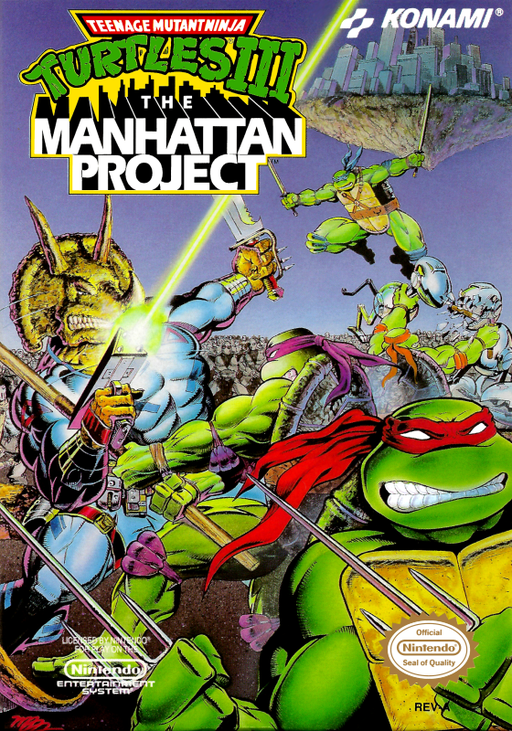
Shredder lifted Manhattan. The entire island, elevated above the city on a flying platform, with April O’Neil captive and the four turtles on vacation in Florida when it happened.
The premise required a game. Konami provided one.
Three Konami TMNT games on NES, each a different approach. The original TMNT (1989) was an action platformer — overhead and side-scrolling sections, Foot Clan infiltration, difficult. TMNT II: The Arcade Game (1990) was the two-player co-op beat-em-up based on the coin-op. Manhattan Project (1992) was the original design not borrowed from an arcade source.
No arcade version meant no arcade constraints. Konami could design eight stages for NES rather than adapting six stages from coin-op. The Super Jump moves — aerial specials unique to each turtle — weren’t in TMNT II because the arcade game didn’t have them. Manhattan Project added them because the designers wanted them and weren’t bound by an existing product.
Each turtle has a jump. The ground attacks are variations of range and speed. The aerial specials are where the four characters diverge into genuinely different play styles.
Leonardo’s aerial sword drop is precise — a forward arc that hits ahead of the landing point. Donatello’s bo spin is horizontal, hitting everything at arm’s length from center. Michelangelo’s nunchuck whirl creates a circular sweep around him. Raphael’s downward sai drives into enemies directly below.
The same enemy configuration approaches differently depending on which turtle jumps into it. The aerial mechanic turns character selection into tactical decision rather than aesthetic preference.
Konami knew the hardware completely by this point — years of NES development had pushed the limits of what the 8-bit hardware could produce. Manhattan Project’s graphical quality is among the NES’s late-era best: sprites clear and distinct, stage backgrounds varied and readable, the visual presentation polished in ways that 1985-era NES games couldn’t achieve.
The game is a demonstration of what expertise with aging hardware produces: not new capabilities, but complete expression of existing ones.
TMNT III: The Manhattan Project is a side-scrolling beat-em-up for one or two simultaneous players. All four turtles playable: Leonardo (sword slash combo), Michelangelo (nunchuck spin), Donatello (bo staff range), Raphael (short sai range, highest individual damage). Each turtle has a unique Super Jump attack — aerial special performed by jumping and pressing attack — that distinguishes their combat style beyond weapon range. Eight stages progressing from Florida beach through Manhattan streets to Shredder's flying island. Two-player simultaneous co-op with friendly fire disabled. April O'Neil must be rescued from Shredder who has placed Manhattan on a levitating island.
TMNT III's NES visuals are among the best beat-em-up graphics on the platform — detailed character sprites, varied enemy designs including classic TMNT villains (Bebop, Rocksteady, Baxter Stockman, Krang, Shredder), and stage backgrounds that convey each setting clearly.
TMNT III's soundtrack by Konami's in-house composers provides stage-appropriate action music with the energetic compositions characteristic of Konami's NES output. The music distinguishes stages and boss encounters effectively.
Eight stages with two-player co-op, four turtle character selection with different combat styles, Super Jump mastery, and the beat-em-up structure of pattern learning across the villain roster provide solid genre replay.
TMNT III: The Manhattan Project (1992) is Konami's third NES TMNT game and the second side-scroller (after TMNT II: The Arcade Game). It was one of the NES's late-era showcases — released in 1992 when the SNES had already launched, demonstrating how much developers had learned to push the aging hardware. The Super Jump moves added turtle-specific aerial attacks absent from TMNT II. The game was NES-exclusive — unlike TMNT II which was a port of the Konami arcade game, Manhattan Project was designed as an original NES title. Combined with TMNT NES (action platformer) and TMNT II (arcade port), it completes the trio of Konami TMNT NES experiences.
.png)
.png)
.png)