Capcom's 1994 SNES fantasy beat-em-up — The King of Dragons follows five character classes (Fighter, Dwarf, Cleric, Elf, Wizard) through a medieval quest to defeat the dragon Gildiss. Experience points level up characters, RPG elements enhance the side-scrolling beat-em-up, and two-player co-op adds a companion for the dragon hunt.
Best Video Games of 1994
All 53 classic games released in 1994 — with reviews, cheats, and trivia.
1994 Games — Page 2
Sorted by ratingCapcom's 1994 SNES Arthurian beat-em-up — Knights of the Round follows Arthur, Lancelot, and Perceval through Medieval England and Camelot's founding, with experience-based leveling that advances character equipment and appearance through seven upgrades per knight. Capcom's most RPG-influenced beat-em-up before The King of Dragons.
Working Designs' acclaimed Sega CD localization of Falcom's action-RPG featuring bounty hunter Mail. Popful Mail's witty dialogue, three-character party system where players switch between characters mid-battle, and CD-quality voice acting made it one of the most beloved Sega CD exclusives — and a landmark in US game localization quality.
Wario's starring debut — a greedier, braver Mario that collects treasure instead of rescuing princesses. Wario Land established one of Nintendo's most creative and underappreciated franchises.
Capcom's darker, more ambitious JRPG sequel — Ryu's second adventure features a township-building mechanic, seven party members with unique combination abilities, and a story that goes to genuinely dark places for a 1994 game.
BlueSky Software's 1994 Genesis RPG-action game based on the Shadowrun tabletop RPG — completely different from the SNES Shadowrun, this version follows Joshua, a street samurai in a cyberpunk Seattle, through a third-person action-RPG perspective with a contract-based mission structure, hacking, magic, and a more open-ended approach than the SNES linear narrative.
Camelot's Sega CD compilation bringing together the two Game Gear Shining Force Gaiden titles with enhancements — Shining Force CD contains the complete Book 1 and Book 2 scenarios (originally Game Gear exclusives), a combined Book 3 scenario unlocked after completion, and CD audio quality for the series' orchestral soundtrack. The definitive version of often-overlooked chapters in the Shining Force saga.
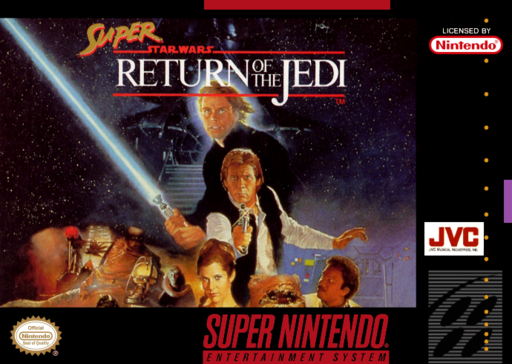
JVC's 1994 SNES action-platformer and the conclusion of the Super Star Wars trilogy — Super Star Wars: Return of the Jedi expands the playable roster to four characters (Luke, Han, Leia, Wicket the Ewok), adapts Episode VI's Tatooine desert, Endor forest, and Death Star II locations with Mode 7 vehicle sequences for the speeder bike chase and Millennium Falcon run, and delivers the series' largest character variety.
The definitive 16-bit Street Fighter experience. Super Street Fighter II Turbo added Akuma as a secret character, rebalanced the roster, and introduced super combos — changes that shaped competitive Street Fighter for years. The SNES version was the closest home approximation of the arcade experience available in 1994.
Koei's ambitious 1994 naval exploration simulation lets players choose from six protagonists in the Age of Sail, trading commodities, discovering new lands, fighting pirates, and mapping the world. One of the most unusual and rewarding games on the SNES, combining trading simulation, naval combat, and historical exploration.
SNK's 1994 Neo Geo sequel and the definitive Art of Fighting experience — Art of Fighting 2 dramatically expands the roster to 12 characters (from 2+2 boss-only in AOF1), adds Robert Garcia, Yuri Sakazaki, and King as fully playable alongside refined special move systems, improves the Spirit Gauge balance, and develops the franchise's story connecting to Fatal Fury's timeline.
Treasure's creative Genesis platformer where protagonist Heady throws his detachable head to attack, solve puzzles, or swap with special heads granting unique powers. Dynamite Heady's constant mechanic variation, inventive level designs, and technical achievement make it one of the Genesis's most creative and underrated games.
Westwood Studios' 1994 Genesis action-platformer based on the Disney film — The Lion King follows young Simba through the film's narrative in nine stages with claw attacks, roar abilities, and one of the generation's most technically impressive platformers. The wildebeest stampede stage and the Scar boss fight are defining Genesis platformer moments.
Blizzard Entertainment's 1994 SNES dark platformer — Blackthorne follows Kyle Vlaros, a prince returning to the planet Tuul after being raised on Earth, shooting his way through alien environments with a shotgun and environmental puzzle mechanics inspired by Prince of Persia's rotoscoped movement. An early Blizzard production with distinctive dark atmosphere.
The PS1 launch title that defined console racing — Ridge Racer's drift-heavy arcade racing with a single course, multiple car classes, and Namco's gallery of unlockable cars from other franchises set the early PlayStation standard.
The final Genesis Streets of Rage built on Streets of Rage 2's foundation with a darker story, faster gameplay, special moves tied to health management, and a more complex combat system. While divisive on release due to its difficulty compared to SoR2, Streets of Rage 3 has grown in reputation as a mechanically deep action game.
SNK's 1994 Neo Geo fighting game and the origin of one of gaming's most enduring franchises — The King of Fighters '94 invented the three-on-three team battle format, assembled characters from Fatal Fury, Art of Fighting, and original creations into tournament brackets, and launched the annual KOF series that continued through KOF 2002 and beyond.
The Genesis basketball game that redefined sports games with its full five-on-five gameplay and complete NBA license. NBA Live 95 combined with Madden 94 established EA Sports as the dominant force in sports gaming — both titles demonstrating that licensed realism could coexist with arcade accessibility.
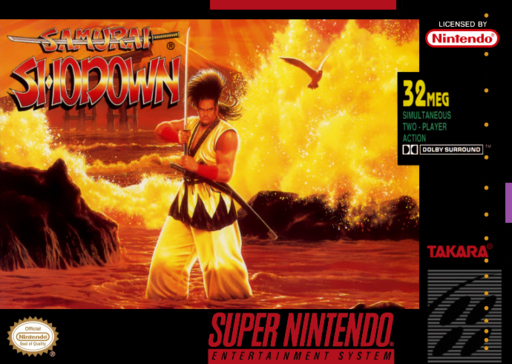
SNK's 1994 SNES port of the Neo Geo weapons-based fighting classic — Samurai Shodown brings the feudal Japan samurai fighter to SNES with 12 characters including Haohmaru, Nakoruru, and Earthquake, the weapon clash and disarm mechanics, rage mode that powers up attacks when health is low, and the game's characteristic one-hit-kill potential that distinguished it from contemporaries.
Widely considered the best original Game Gear Sonic experience. Triple Trouble's varied level designs, playable Knuckles echidna with unique routes, and polished animation made it the standout title in Sega's portable Sonic lineup. The search for six Chaos Emeralds drives an adventure that holds up decades later.
Software Creations' 1994 SNES beat-em-up based on the Maximum Carnage comic arc — Spider-Man and Venom team up across 14 stages fighting Carnage's gang. The game is notable for its red SNES cartridge (one of very few), the music by Green Jellÿ and Zoebleed, and two selectable protagonists with different combat capabilities.
The racing franchise that started it all — the original Need for Speed featured real exotic cars from Ferrari, Lamborghini, and Porsche with full-motion video car profiles, police pursuits, and a revolutionary sense of speed for 1994.
The arcade fighting game that launched one of gaming's most enduring fighting franchises, Tekken brought 3D movement, eight distinct fighters, and the fluid four-limb control system to the PlayStation in 1994, helping establish Sony's console as the new home of arcade fighters.